Angels Landing vs Half Dome: which trail should you hike?
Yosemite has two trails that define what it means to go vertical in the Sierra. Half Dome sends you up the park's most iconic granite monolith, a 16.5-mile e...
Yosemite has two trails that define what it means to go vertical in the Sierra. Half Dome sends you up the park's most iconic granite monolith, a 16.5-mile endurance test that ends with a cable-assisted scramble up bare rock. Yosemite Falls Trail climbs beside North America's tallest waterfall, a 7.6-mile lung-burner that trades distance for relentless elevation gain. Both are strenuous, both are spectacular, and both will have you questioning your life choices around the halfway point.
The question isn't which one is harder. They're both hard, just in different ways. Half Dome is a full-day commitment with exposure that will test anyone with a fear of heights. Yosemite Falls is shorter but steeper, packing nearly as much elevation into half the distance. The real question is what kind of suffering you prefer: the marathon grind with a technical finish, or the sprint that never lets up.
Here's how they compare when you're actually on the trail, not just reading about it from your couch.
The Approach
Half Dome starts gently. You'll leave Happy Isles and spend the first few miles on the Mist Trail, passing Vernal and Nevada Falls with views that belong on postcards. The elevation comes in waves, but the trail stays engaging, winding through forest and granite staircases with enough visual payoff to distract you from the mileage. By the time you reach the base of Sub Dome, you've already hiked farther than most people do in a day, and you still have the hardest part ahead of you.
Yosemite Falls Trail has no warm-up. From the trailhead near Camp 4, you're immediately climbing tight, rocky switchbacks that feel designed to break your spirit. The first mile gains more than 1,000 feet, and the shade is inconsistent. You'll catch glimpses of the falls through the trees, but mostly you're just grinding upward, counting switchbacks, and wondering why you didn't start at dawn.
Half Dome lulls you into complacency with waterfalls and forest; Yosemite Falls tells you exactly what you're in for from step one.
The Climb
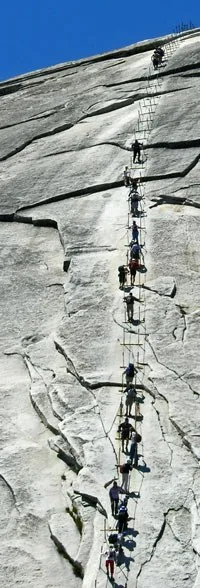
Half Dome saves its defining challenge for the end. Sub Dome is a steep granite staircase with metal handrails bolted into the rock, exposed enough that you'll feel the drop but manageable if you take it slow. The cables are where the trail becomes something else entirely. You're pulling yourself up a 45-degree granite face using steel cables, with wooden planks every few feet for footholds. It's more physically demanding than it looks, and the exposure is real. If you freeze up on ladders or get dizzy near cliff edges, this will test you.
Yosemite Falls spreads the suffering more evenly. After the initial switchback assault, the trail continues climbing but never relents. The middle section offers brief flat stretches where you can catch your breath, but the upper section grinds through talus fields and exposed granite slabs. There's no single dramatic feature like the cables, just relentless upward movement. Your legs will give out before your nerves do.
Half Dome asks if you can handle exposure and heights; Yosemite Falls asks if your quads have another thousand feet in them.
The Payoff
Standing on top of Half Dome is surreal. The summit is a broad, gently domed plateau about the size of a football field, with 360-degree views that stretch from Tenaya Canyon to the High Sierra backcountry. You can see Clouds Rest, the Cathedral Range, and the entire sweep of Yosemite Valley below. The exposure is dizzying but the space feels secure. You'll want to sit, eat, and absorb the fact that you just climbed one of the most recognizable pieces of rock in the world.
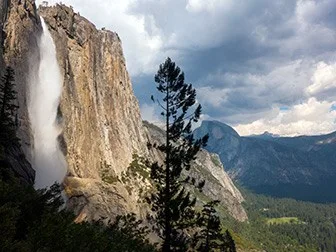
The top of Yosemite Falls offers a different reward. You're standing at the brink of North America's tallest waterfall, watching the Merced River launch itself into space and drop more than twice the height of the Empire State Building. The view opens up to the valley floor and the High Sierra beyond, but the real thrill is the water. In late spring, the roar is deafening and the mist soaks everything within 50 feet of the edge. By August, the falls slow to a trickle, but the view stays dramatic.
Half Dome gives you the summit and the icon; Yosemite Falls gives you the raw power of water and gravity.

The Crowds
Half Dome requires a permit, which caps the number of people on the cables each day. That sounds like a crowd control victory until you're stuck behind a line of hikers on Sub Dome, waiting your turn to clip onto the cables. Weekends in July and August can mean 30-minute waits just to start the cable section, and the descent is worse because you're facing downhill with less control. The lottery system keeps the cables from becoming a gridlock nightmare, but it doesn't make the trail feel empty.
Yosemite Falls has no permit, which means the lower section can feel like a parade on summer mornings. Most day hikers turn around at Columbia Rock, about a mile up, which thins the crowds significantly. By the time you reach the upper falls, you'll share the trail with far fewer people. Early morning starts help, but even midday the upper section feels spacious compared to the lower switchbacks.
Half Dome rations the crowds with permits; Yosemite Falls lets attrition do the work.
Which One Should You Choose?
Choose Half Dome if you want the iconic Yosemite summit, you're comfortable with exposure and heights, and you have the endurance for a 10-hour day. This is the hike that ends up in your photo album and your stories for the next decade. It's a bucket-list experience, but it demands preparation, fitness, and a permit secured months in advance. If you're visiting Yosemite to check off the big one, this is it.
Choose Yosemite Falls if you want a shorter but equally challenging climb, you'd rather stand at the top of a waterfall than a granite dome, or you don't want to deal with the permit lottery. This trail rewards strong hikers who can handle sustained elevation gain without the technical exposure of the cables. It's less famous but just as demanding, and the waterfall payoff is more dynamic than any static summit view.
If you have the time and fitness for both, do them on separate days and start each one before dawn. Half Dome first, because the permit forces you to plan ahead. Yosemite Falls second, because you'll appreciate the shorter distance after logging 16 miles on granite. Both trails will wreck you in the best possible way, and neither will leave you wondering if Yosemite lives up to the hype.