Cleetwood Cove Trail vs Cold Springs Nature Trail: Which Trail Should You Hike?
Crater Lake offers two radically different ways to experience its famous rim, and choosing between them says more about your hiking philosophy than your fitn...
Crater Lake offers two radically different ways to experience its famous rim, and choosing between them says more about your hiking philosophy than your fitness level. The full Rim Trail is a multi-meal commitment that requires either a very long day or an overnight permit, circling the entire caldera through sections that range from paved tourist promenades to rocky singletrack where you might not see another soul for hours. The Watchman Trail is a sub-two-hour appetizer that delivers the money shot without the suffering, climbing to a historic fire lookout where the lake spreads out below you like a geography lesson in why this place became a national park.
Both trails share the same core attraction: unobstructed views of a collapsed volcano filled with water so blue it photographs like a Photoshop mistake. But the Rim Trail treats the lake as a constant companion on an endurance test, while the Watchman treats it as a crescendo you earn after a short, steady climb. The question is not which trail is better, but which relationship you want with Crater Lake on this particular trip.
The Rim Trail draws completionists and backpackers who want the full story, while the Watchman pulls families, photographers chasing sunset, and anyone who has learned that short hikes can punch above their mileage. If you have only one afternoon at Crater Lake, the Watchman wins by default. If you have two days and a taste for Type 2 fun, the Rim Trail becomes one of the most rewarding rim-to-rim routes in any national park.
The Commitment
The Rim Trail demands somewhere between fifteen and twenty hours of continuous hiking if you tackle it in one push, which means starting in predawn darkness and finishing well after sunset even in the long days of August. Most hikers break it into an overnight backpacking trip, camping at one of the designated backcountry sites along the rim. Either way, you are signing up for a full day of hiking that requires planning around food, water resupply, and the reality that once you are halfway around, the shortest way out is to keep going.
One trail asks for your entire day and maybe your next morning; the other asks for ninety minutes and gives you the afternoon back.
The Watchman Trail, by contrast, fits neatly into the gap between breakfast and lunch or the golden hour before dinner. You can hike it on a whim without packing more than a water bottle and a camera. It does not require advance planning, does not demand an early start, and leaves you with enough energy to drive to another overlook or hit a second short trail before the sun sets.
The Terrain
The Rim Trail stitches together paved sections along Rim Drive with primitive singletrack that winds through pumice fields, forests of mountain hemlock, and rocky stretches where the trail becomes little more than cairns marking the route. You will walk past every major overlook in the park, but you will also trudge through miles of forest where the lake disappears from view and the scenery becomes a monotonous parade of lodgepole pine and volcanic rock. The elevation gain accumulates in lumps rather than one sustained climb, with rolling terrain that never lets your legs settle into a rhythm.
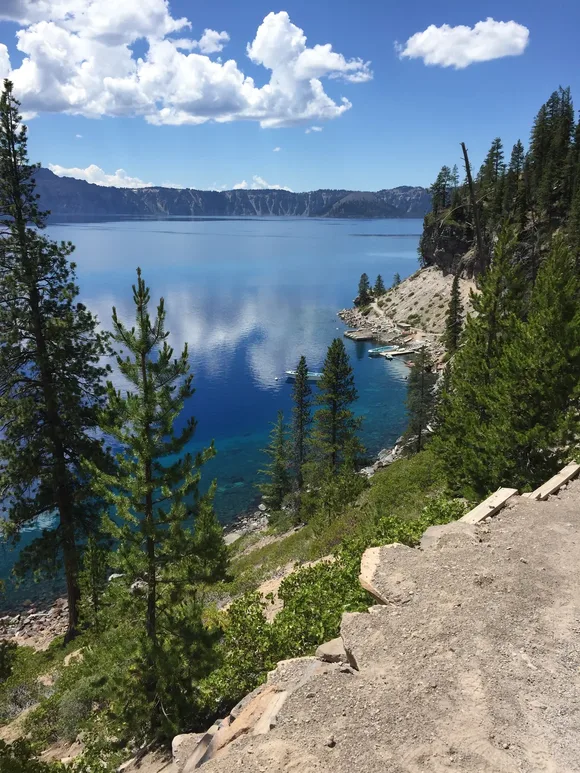
The Watchman Trail stays civilized from start to finish. The path is wide, the grade is steady, and the switchbacks are engineered to make the elevation gain feel manageable even for hikers who do not spend weekends grinding out vertical. You climb through wildflower meadows in late July and early August, with lupine and Indian paintbrush adding color to the volcanic soil. The final push to the lookout station involves a bit of exposed scrambling over rock, but nothing that requires hands or makes you question your footing.
The Rim Trail makes you work for every perspective; the Watchman hands you the best one after a climb that feels more like a warm-up.
The Views
The Rim Trail delivers every possible angle on Crater Lake, from the popular overlooks where tour buses disgorge passengers to hidden stretches of rim where you can sit in silence and stare at Wizard Island without another human in your peripheral vision. You see the lake in morning light, midday glare, and evening alpenglow. You watch the color shift as the sun moves across the sky. You get intimate with the caldera in a way that drive-up tourists never will, and by the end, you have earned a proprietary relationship with this place.
The Rim Trail gives you the complete visual biography; the Watchman gives you the cover shot.
The Watchman Trail offers what might be the single best view in the park from the historic fire lookout perched on the rim. You stand at an elevation where the lake spreads out below you with Wizard Island centered in the frame like a postcard composed by a perfectionist. The west-facing aspect means late afternoon and sunset light turn the water from blue to cobalt, and the lack of forest obstruction means you can set up a tripod and shoot without branches photobombing your composition. If you want one killer photo without hiking all day, this is the trail.
The Crowds
The Rim Trail sees remarkably few hikers attempting the full loop, which means most of your day unfolds in solitude broken by brief encounters at the major overlooks where the trail intersects Rim Drive. The sheer length filters out casual hikers, and even on busy summer weekends, the trail never feels crowded. You might go hours without seeing another backpacker, especially on the east rim sections that lack roadside access.
The Watchman Trail, by contrast, is one of the park's most popular short hikes, and the trailhead parking lot fills by mid-morning on summer weekends. You will share the path with families, retirees, and European tourists who have read the same guidebooks you have. The summit lookout can feel like a cocktail party at peak times, with people jockeying for photo angles and kids running around the historic structure. It is not Disneyland, but it is not wilderness either.
One trail trades crowds for exhaustion; the other accepts company as the price of efficiency.
Which One Should You Choose?
Choose the Rim Trail if you want the complete Crater Lake immersion and have the time, fitness, and gear to commit to either a very long day or an overnight trip. This trail rewards hikers who find satisfaction in covering distance and checking off achievements. It is the best option for backpackers who want to sleep under the stars on the rim, photographers who need every possible angle, and anyone who believes that trails should be hard-won experiences rather than quick hits.
Choose the Watchman Trail if you want the iconic Crater Lake view without sacrificing the rest of your day. This trail is the smart play for families with kids who can handle a bit of uphill, visitors who are sampling multiple parks on a road trip, and photographers who would rather spend twenty minutes at one perfect location than eight hours chasing a dozen mediocre ones. It is also the better choice if you are visiting in late June or early October, when snow still blocks sections of the Rim Trail but the Watchman stays accessible.
If you have two days at Crater Lake, you can do both: hike the Watchman at sunset on your first evening, then tackle the full Rim Trail as a backpacking trip the next day. But if you are choosing between them for a single outing, let your schedule and your ego decide. The Rim Trail is a test you pass by finishing. The Watchman is a gift you accept by showing up.