Shriner Peak Fire Lookout vs Easy Pass Trail: Which Trail Should You Hike?
Two iconic trails in two different parks. Shriner Peak Fire Lookout in Mount Rainier and Easy Pass Trail in North Cascades, compared on distance, elevation, difficulty, and overall experience.
Two North Cascade peaks. Two fire lookout destinations. Two trails that promise alpine vistas after brutal climbs. But Mount Rainier's Shriner Peak Fire Lookout and North Cascades' Easy Pass Trail deliver fundamentally different experiences despite their similar vital statistics. One is a methodical grind through forest to a perfectly restored lookout perched on a summit. The other is a deceptively named assault on a high mountain pass that opens into a cirque of jagged peaks and wildflower meadows.
Both trails clock in around eight miles roundtrip with elevation gains topping half a vertical mile. Both demand early starts and strong legs. But the Shriner Peak route is a fire road masquerading as a trail, wide and relentless, built for pack mules hauling supplies to the lookout. Easy Pass, by contrast, is a North Cascades classic: steep, raw, and willing to make you work for every switchback before dumping you into one of the range's most dramatic cirques.
The choice isn't about difficulty. It's about what kind of suffering you prefer and what you want waiting at the top.
The Approach
Shriner Peak doesn't waste your time with scenic warm-ups. The trail starts climbing immediately from the trailhead off SR 123, gaining elevation at a rate that would make most trails blush. It's an old fire road, which means every step is on packed dirt wide enough for two people to walk side by side. There's nothing technical here, nothing that requires hands or careful foot placement. Just four miles of sustained climbing through dense Douglas fir and western hemlock that blocks most views until you're nearly at the summit.
Easy Pass, despite its name, makes no pretense of hospitality. The trail leaves the parking area on a gradient that announces its intentions within the first hundred yards. You'll climb through old-growth forest for the first two miles, crossing avalanche chutes that open brief windows onto the peaks above. The path is narrower, rockier, and far more varied than Shriner's fire road. Where Shriner is a grinding march, Easy Pass is a scramble that shifts character every half mile.
The Climb
Shriner Peak gains more than three thousand feet over four miles, which works out to an average grade that never lets up. The fire road's consistent width means you can settle into a rhythm, but the lack of switchbacks means you're always pushing upward at the same punishing angle. The forest canopy keeps the sun off your back but also traps the heat on warm days. You'll hear Rainier before you see it, the rumble of glacial melt echoing through the trees.
Easy Pass spreads three thousand feet of climbing over three and a half miles, but the gradient is anything but consistent. The lower forest section is steep but manageable. Then the trail breaks into open meadows and the real work begins. The final mile to the pass is a war of attrition, a seemingly endless series of switchbacks carved into loose talus and dirt. Every step forward feels like half a step back. The views, at least, improve with every hundred feet of elevation.
The Payoff
Shriner Peak's summit delivers what it promises: a fully restored fire lookout perched on a rocky pinnacle with views that stretch from Mount Rainier to Mount Adams. The lookout itself is a piece of park history, staffed in summer by volunteers who can tell you what you're looking at. The summit is small, rocky, and exposed, with just enough room for a handful of hikers to spread out and catch their breath. Rainier dominates the western skyline, close enough to see the glaciers carving down its flanks.
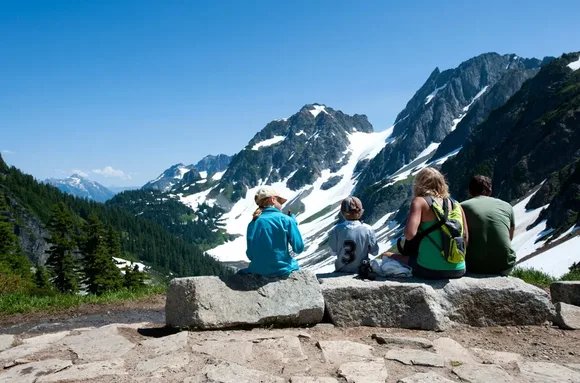
Easy Pass opens into a different kind of drama. The pass itself is a narrow notch carved between Fisher Peak and Mesahchie Peak, with views down into the Fisher Creek drainage and up toward the jagged spine of the North Cascades. In late summer, the meadows below the pass explode with lupine, paintbrush, and heather. The cirque amplifies the sense of scale, peaks rising in every direction like broken teeth. There's no structure here, no human-made focal point. Just rock, ice, and wildflowers.
The Crowds
Mount Rainier's popularity works against Shriner Peak. The park draws more visitors than the entire population of Los Angeles spreads across the summer season, but most of those crowds stick to Paradise and Sunrise. Shriner Peak, tucked in the quieter southeast corner near the Stevens Canyon entrance, sees a fraction of the traffic. You'll likely share the trail with a handful of other hikers, but the summit can feel crowded if more than five people arrive at once.
North Cascades National Park is one of the least-visited parks in the country, and Easy Pass sits deep enough in the backcountry to filter out the casual tourists. The trailhead requires a long drive on the North Cascades Highway, which keeps the numbers down. On weekdays, you might have the pass entirely to yourself. On summer weekends, expect to see a few other parties, but nothing approaching the crowds at more accessible North Cascades trails like Cascade Pass or Blue Lake.
The Verdict
Shriner Peak is the better choice if you value efficiency over variety. The trail is straightforward, the destination is clear, and the views are spectacular without requiring navigation skills or route-finding instincts. It's a grind, but it's an honest grind with a tangible reward at the top. The fire lookout gives you something to aim for beyond just elevation gain.
Easy Pass rewards hikers who prefer raw alpine terrain over engineered experiences. The trail is more technical, the scenery more varied, and the destination less defined. If you want a summit with a structure, choose Shriner. If you want to stand in a high mountain pass surrounded by peaks with no guide, no signs, and no crowds, choose Easy Pass.
Which One Should You Choose?
Choose Shriner Peak Fire Lookout if: you want a clear destination with a historic fire lookout, you prefer wide trails over technical scrambles, you're drawn to Mount Rainier's volcanic presence, or you're willing to trade variety for a straightforward route to big views.
Choose Easy Pass Trail if: you're comfortable with sustained steep climbing on loose terrain, you want wildflower meadows and alpine cirques over summit structures, you prefer remote North Cascades solitude to Mount Rainier's busier trails, or you're looking for a launching point to explore higher ridges and peaks beyond the pass.