Kīlauea Episode 52 fountains 500 feet into the full-moon sky — what to know before your visit
Kīlauea Episode 52 is fountaining 500 feet into the August sky, and the park's viewing areas are wide open
Kīlauea started erupting again on June 26, 2025, and the fountains haven't stopped. Episode 52 is sending molten rock 500 feet into the air above Halemaʻumaʻu Crater, visible from the Crater Rim Trail and several roadside pullouts. If you've been waiting for the right time to visit Hawaiʻi Volcanoes, this is it.
The park stays open during eruptions unless sulfur dioxide levels spike or ground cracking threatens infrastructure. Right now, you can watch lava fountaining from multiple vantage points without permits or special access. The show runs 24 hours, but the full moon in August turns the volcanic plume into something you won't see anywhere else on Earth.
Hawaiʻi Volcanoes National Park
Two active volcanoes on one island / Eruption visible from roadside pullouts
Hawaiʻi Volcanoes gives you what Yellowstone's geysers only hint at: the Earth opening up and pouring itself out in real time. Episode 52 is filling Halemaʻumaʻu Crater with a lava lake that pulses and spatters throughout the day, throwing fountains higher than the Washington Monument when the vent pressure builds. The glow reflects off the steam plume at night, turning the crater rim into a natural amphitheater for geology in motion. Most parks ask you to imagine the forces that shaped them. Here, you watch those forces at work.
The crater doesn't care about your schedule, and that's exactly why you should clear yours to watch it.
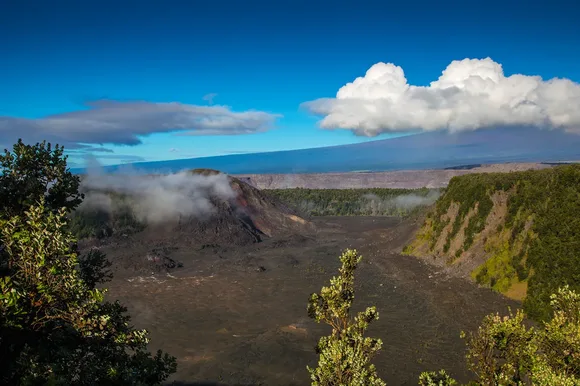
Crater Rim Trail skirts the edge of Kīlauea Caldera for 11 miles, but you don't need to walk the whole thing to see the eruption. The Uēkahuna viewing area sits less than a mile from the Visitor Center and offers the best daytime perspective on the lava lake. Steam Bluffs gives you a slightly different angle, and Keanakākoʻi Crater adds context for what Kīlauea looked like before the 2018 collapse. All three are wheelchair accessible. If you want solitude, hike past the first viewpoint on Crater Rim Trail toward Kīlauea Iki; most visitors stop at the overlooks, so a 20-minute walk puts you almost alone with a view that rivals any roadside pullout.
August is prime time for two reasons: the weather cooperates, and the full moon on August 9 will light the volcanic plume like a stage. Daytime temperatures stay in the low 70s at the summit, which sits at 4,000 feet and cools off fast after sunset. Bring layers. The eruption has been continuous since late June, but volcanic episodes don't follow a schedule. Kīlauea has paused mid-episode before, sometimes for days. If you're booking flights around the eruption, build in flexibility.
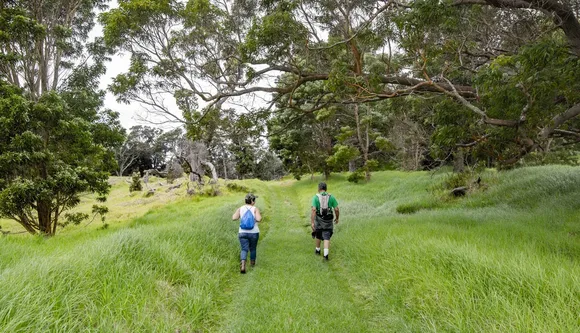
Chain of Craters Road descends 3,700 feet over 19 miles, cutting through lava flows from 1969, 1974, and 2018. The road ends abruptly where the 2018 flow buried the pavement under 60 feet of rock. You can park and walk out onto the black crust, still warm in places, and see how quickly the land reclaims itself. Native ʻōhiʻa trees sprout from cracks in five-year-old lava. Ferns colonize the edges. The drive takes 90 minutes round trip if you don't stop, but you'll stop. Pull over at Maunaulu to see a shield volcano that erupted for five years straight in the 1970s, or hike the half-mile spur to Puʻu Loa Petroglyph Field, where more than 23,000 carvings cover the paʻhoehoe lava.
Kīlauea Iki Trail drops 400 feet into a crater that erupted in 1959 and now looks like a moonscape crossed with a rainforest. The four-mile loop starts in jungle so thick you can't see 20 feet ahead, then spits you out onto a lava lake that solidified into a cracked black plain. Steam vents hiss along the trail, reminding you the rock beneath your feet is still cooling 60 years later. Rangers recommend starting early; the crater floor has no shade, and the climb back out is steep enough to make you reconsider your fitness level.

Thurston Lava Tube offers the easiest payoff in the park. A half-mile paved loop takes you through a tunnel carved by molten rock 500 years ago, wide enough to walk through without ducking and lit well enough for kids to explore without headlamps. The parking lot fills by 10 a.m. on weekends, but the trail moves fast. If you want a lava tube without the crowds, try the Nāpau Crater Trail, which passes several collapsed sections where you can scramble into unlit tunnels with a flashlight and a willingness to get dirty.
Ranger programs run twice daily from the Visitor Center, covering everything from volcanic gases to native bird conservation. The After Dark in the Park series happens Tuesday nights and pulls in local scientists, cultural practitioners, and Park Service researchers for talks that go deeper than the standard geology 101. August's lineup includes a presentation on Kīlauea's eruptive history and a workshop on traditional Hawaiian wayfinding. Both are free, and both fill up fast.