Redwood vs Sequoia: which park should you visit?
Redwood grows the tallest trees on Earth in coastal fog; Sequoia grows the largest in high Sierra granite
California's tall trees come in two forms: the coastal redwoods that push taller than any other tree on Earth, and the giant sequoias that grow wider than buses. The parks protecting them sit on opposite sides of the state, separated by four hundred miles and fundamentally different ways of being a forest. Redwood gives you height and fog and moss in a narrow coastal strip. Sequoia gives you mass and granite and high country that stretches into the Sierra backcountry.
You won't confuse them once you arrive. Redwood feels like walking through the nave of a green cathedral, humid and quiet and draped in ferns. Sequoia feels like standing at the feet of something older than memory, where the trunks are so wide you lose perspective on distance.
Redwood National and State Parks
The tallest trees on Earth / A third the crowds of most coastal parks
The coast redwoods here top out above three hundred feet, tall enough that their crowns disappear into summer fog. You can walk among them on flat, accessible trails that feel nothing like the steep scrambles most people associate with California parks. Lady Bird Johnson Grove and the Cathedral Trees loop through old-growth stands where the forest floor stays soft with sorrel and the light filters down in shafts. These aren't grueling hikes; they're immersive walks where the effort goes into tilting your head back far enough to see the canopy.
The redwoods don't just grow tall — they create an entire vertical ecosystem you can't see from the ground.
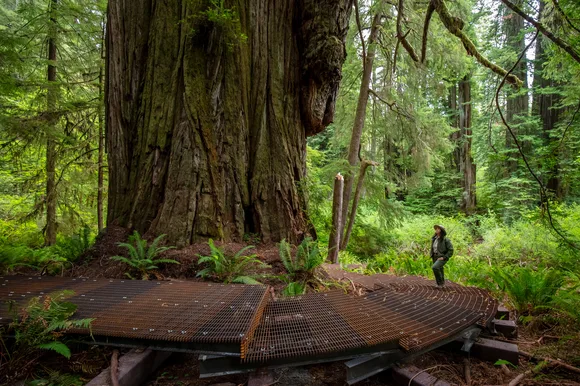
Fern Canyon delivers what the name promises: walls of five-finger ferns rising fifty feet on both sides of a narrow creek bed. You'll walk through ankle-deep water for most of the loop, stepping on stones and fallen logs while the canyon walls close in overhead. It's the kind of place that shows up in dinosaur movies because it genuinely looks prehistoric. The coast here stays cool even in summer, with highs in the low seventies and fog that rolls in most afternoons. June brings the best balance of clear mornings and green forest, but August and September stretch the dry season without the summer marine layer.
Sequoia & Kings Canyon National Parks
The largest tree on Earth by volume / More trail miles than the entire East Coast has redwoods
General Sherman doesn't look possible. The trunk exceeds thirty feet in diameter, wider than most studio apartments, and keeps that girth for over a hundred feet before the first branches appear. You'll walk a paved half-mile trail down to the tree, which sits in Giant Forest among thousands of other sequoias that would be famous anywhere else. The scale doesn't register in photos. You have to stand at the base and try to wrap your mind around something that weighs more than ten blue whales.
Sequoias grow so large that their lowest branches are thicker than most old-growth trees back East.
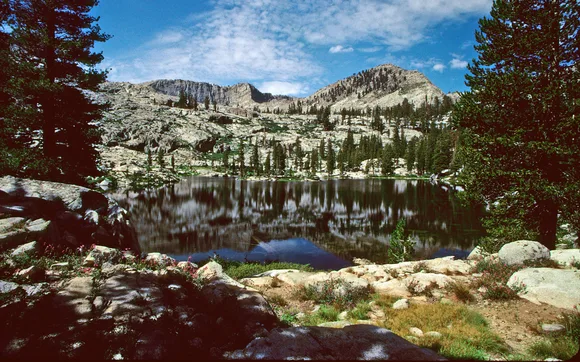
Moro Rock puts you above the Giant Forest on a granite dome reached by a quarter-mile staircase carved into stone. The Sierra high country unfolds to the east, all granite peaks and alpine basins, while the Central Valley haze fills the western horizon. Kings Canyon adds a second dimension to the park: a river-carved gorge that drops deeper than the Grand Canyon in places, lined with waterfalls in June when snowmelt peaks. The park absorbs visitors across fifteen campgrounds and seven hundred miles of trail, most of it in wilderness that sees almost no one. Summer highs in the Giant Forest stay in the mid-seventies, but the elevation keeps nights cool enough for a sleeping bag rated to freezing.

Choose Redwood if you want coastal access, temperate rainforest ecology, and trails you can do in trail runners without gaining serious elevation. The park stays green year-round, and you can combine it with the Oregon coast or Crater Lake on a longer loop. Choose Sequoia if you want alpine access, high-country backpacking, and the chance to see trees so large they redefine what a forest can be. The Sierra Nevada backdrop adds granite domes, glacier-carved valleys, and enough backcountry to disappear for a week.