Thornton Lake Trail vs Half Dome: Which Trail Should You Hike?
Two iconic trails in two different parks. Thornton Lake Trail in North Cascades and Half Dome via Sub Dome in Yosemite, compared on distance, elevation, difficulty, and overall experience.
These trails occupy different corners of the national park universe. Thornton Lake climbs through the forgotten wilderness of North Cascades, where the trail itself is half the challenge and solitude is the reward. Half Dome is American hiking royalty, the kind of summit that dominates bucket lists and Instagram feeds in equal measure. One is a route to a secret alpine lake that most park visitors will never see. The other is a vertical pilgrimage up Yosemite's most iconic granite face.
The comparison feels almost unfair. Half Dome draws more hikers in a weekend than Thornton Lake sees in a season. But that's precisely why it's worth examining: these trails represent two fundamentally different philosophies about what makes a hike worth doing. If you're choosing between them, you're really choosing between anonymity and legend, between wilderness navigation and engineered adventure.
The Approach
Thornton Lake begins on what used to be a logging road, which tells you everything about its pedigree. The first two miles punish you with relentless uphill on a trail that's more suggestion than infrastructure. Roots cross the path like trip wires. Deadfall blocks the way. The forest is so thick you can't see ten feet in any direction. This is North Cascades reminding you that it doesn't care whether you make it to the lake or not.
Half Dome starts from Happy Isles, one of Yosemite's most trafficked trailheads, and for the first several miles you're essentially hiking through a waterfall showcase. Vernal Fall, Nevada Fall, the Merced River cutting through polished granite. The trail is well-maintained, heavily signed, and populated with day-hikers who'll turn back long before you reach the cables. It's beautiful in a way that feels almost orchestrated.
The Climb
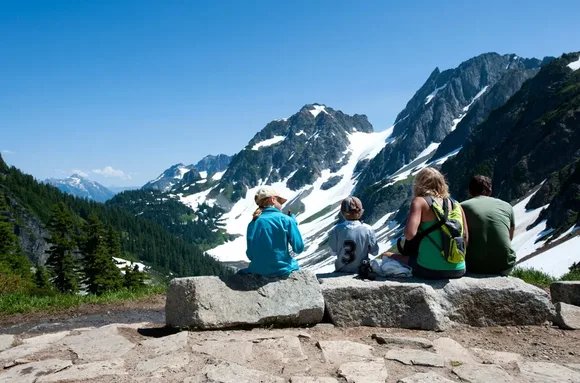
Thornton Lake gains elevation like it's trying to prove something. The trail climbs through old-growth forest on a grade that never quite lets up, and the footing is technical enough that you're watching your feet more than the scenery. Around the halfway point the forest starts to thin and you catch your first views of the surrounding peaks. The final push breaks out into subalpine meadows where the trail becomes harder to follow but the landscape opens up into something genuinely wild.
Half Dome's elevation gain is nearly double Thornton Lake's, but it's spread over more distance and broken into distinct acts. The climb past the waterfalls is steady but manageable. The granite staircases are steep but stable. The real test comes on Sub Dome, where the trail turns into a series of switchbacks carved into near-vertical rock. By the time you reach the cables, you've already climbed higher than most mountains in the eastern United States.
The Payoff
Thornton Lake sits in a granite cirque below Trappers Peak, surrounded by talus slopes and scattered alpine firs. The water is the kind of blue-green that only happens at elevation, fed by snowmelt and shaded by peaks that hold snow well into summer. Most days you'll have the place to yourself. The lake isn't the end of the trail, it's the beginning of the alpine zone. Scramble routes lead higher into the basin, and if you're comfortable with off-trail navigation, you can reach a second lake that doesn't appear on most maps.
Half Dome's summit is a granite platform roughly the size of a football field, with vertical drops on three sides and views that redraw your understanding of what landscape can do. You can see the entire length of Yosemite Valley. You can trace the High Sierra crest from Clouds Rest to Mount Lyell. On clear days you can see peaks in the eastern Sierra that are over a hundred miles away. The summit is usually crowded, but the scale of the place absorbs the people.
The Crowds
Thornton Lake is one of the least-hiked trails in North Cascades National Park, which itself sees fewer visitors annually than Yosemite gets in a busy weekend. You might encounter a handful of backpackers heading to the campsites at the lake, or a day-hiker who studied the map long enough to know this trail exists. More likely you'll see no one. The parking area holds maybe a dozen cars, and it's rarely full.
Half Dome is a permit lottery that thousands of people enter and lose. Even with the cables limiting access, you'll share the route with dozens of other hikers, possibly hundreds on peak weekends. The cables themselves become a bottleneck where you're waiting in line for your turn to clip in and climb. The summit can feel like a crowded observation deck during midday in summer. This is the price of hiking an icon.
Which One Should You Choose?
Choose Thornton Lake if you want wilderness that still feels wild, if solitude matters more than famous views, if you're comfortable with route-finding and rough trail conditions, or if you want to experience what North Cascades does better than any park in the lower forty-eight: complete immersion in mountain landscape without the crowds.
Choose Half Dome if you want to stand on one of the most recognizable summits in American hiking, if you're willing to share the experience with other hikers, if you want infrastructure and permits in exchange for safety and access, or if you believe some trails earn their reputation honestly and deserve to be hiked despite the crowds.