Warren Peak vs Gobblers Knob Fire Lookout: Which Trail Should You Hike?
Two iconic trails in two different parks. Warren Peak in Joshua Tree and Gobblers Knob Fire Lookout in Mount Rainier, compared on distance, elevation, difficulty, and overall experience.
One's a desert peak in Southern California where Joshua trees give way to juniper forests. The other's a historic fire lookout in the shadow of Mount Rainier's glaciated bulk. Warren Peak and Gobblers Knob couldn't be more different in landscape, but they share a common thread: both reward those willing to work for their views with a summit experience most park visitors never see.
Warren Peak sits in Joshua Tree's western half, the section most people skip on their way to the Instagram-famous rocks and cholla gardens. Gobblers Knob perches on a ridge above Mount Rainier's west side, accessible only after walking nearly half the distance on a closed road. Both trails demand commitment, both offer solitude that's increasingly rare in our national parks, and both deliver summit views that justify every step of elevation gain.
The question isn't which trail is better. It's which kind of summit experience you're after: the exposed granite knob of a high desert peak, or the fire lookout view of a massive volcano framed by old-growth forest.
The Approach
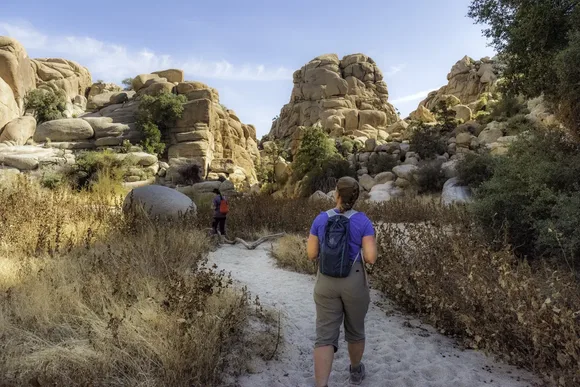
Warren Peak starts from Black Rock Canyon, the campground and trailhead area that feels more like the Eastern Sierra than the Mojave Desert. You'll park at an elevation where pinyon pine and juniper actually grow, a jarring change if you've spent the morning in the main park's cactus gardens. The trail climbs from the start, but the grade stays manageable through terrain that's surprisingly green for a desert environment.
Gobblers Knob makes you earn the trail before you even start hiking. The first three miles follow Westside Road, a paved former access route that's been closed to vehicles since a series of washouts made it too expensive to maintain. You'll be walking on asphalt, gaining minimal elevation, watching the forest slowly change as you approach the actual trailhead at Lake George. It's not scenic, it's not what you came for, and it adds nearly an hour to your day before the real climbing begins.
The Climb
Warren Peak's eleven hundred feet of elevation gain spread across just over three miles feels steeper than the numbers suggest. The trail follows ridgelines and rocky sections where you'll need to pick your route carefully, especially on the descent. As you climb, the vegetation shifts from juniper woodland to exposed granite slabs where nothing grows except lichen. The final push to the summit involves some easy scrambling, nothing that requires hands-on-rock expertise, but enough to make it feel like you're mountaineering rather than just hiking.
Gobblers Knob's twenty-six hundred feet of gain comes in two distinct phases. The first half climbs through old-growth forest on a well-maintained trail that could be anywhere in the Cascades. The second half breaks out of the trees and traverses alpine meadows where wildflowers peak in late July and early August. The final mile to the lookout tower pushes up a ridge where every switchback reveals more of Mount Rainier's western face, close enough to see individual glaciers and rock bands.
The Payoff
Warren Peak's summit is a granite dome barely wide enough for a half-dozen hikers to spread out comfortably. The view stretches across the entire western half of Joshua Tree, a landscape of buff-colored rock and green-dotted valleys that looks nothing like the main park's tourist corridors. On clear days, you can see San Gorgonio and San Jacinto to the west, the two highest peaks in Southern California. To the east, the Pinto Basin stretches toward the horizon, a reminder that this desert goes on for hundreds of miles beyond the park boundary.
Gobblers Knob's fire lookout still stands, maintained by volunteers who occasionally staff it during fire season. You can climb the stairs to the catwalk and stand where generations of lookouts watched for smoke. But the real payoff is Mount Rainier itself, dominating the eastern skyline like a wall of ice and rock. The summit sits closer than eight miles away as the crow flies, close enough to see the texture of the glaciers, far enough to comprehend the mountain's massive scale. On clear afternoons, the Nisqually Glacier catches the sun and glows against the dark rock bands below the summit dome.
The Crowds
Warren Peak sees fewer hikers in a month than the Hidden Valley Nature Trail sees in an hour. Black Rock Canyon sits far enough from the main park entrance that most visitors never make the drive, and the trail's reputation as Joshua Tree's most challenging summit keeps casual hikers away. You'll likely have the trail to yourself on weekdays, and even on weekends you might see only a handful of other parties.
Gobblers Knob's three-mile road walk acts as a natural filter. Most Mount Rainier visitors stick to the more accessible trails around Paradise and Sunrise, and those willing to drive to the park's west side usually choose shorter hikes to waterfalls or lakes. The result is a trail that feels empty compared to the park's congestion index of seven out of ten. You might see a dozen other hikers over the course of the day, but you'll have long stretches of solitude and a summit that's often completely empty.
Which One Should You Choose?
Choose Warren Peak if you want a desert summit that feels more like alpine hiking than most people expect from Joshua Tree. Choose it if you're visiting between late October and March when the temperatures make the exposed climb manageable. Choose it if you want to see the side of the park that doesn't appear in guidebook photos, and if you're comfortable with a trail that requires route-finding skills and a tolerance for loose rock underfoot.
Choose Gobblers Knob if you want to see Mount Rainier from an angle most visitors never experience. Choose it if you're willing to trade the road walk for the payoff of standing at a working fire lookout with glacier views. Choose it if you're hiking between mid-July and September when the snow has cleared and the wildflowers are blooming in the alpine meadows. Choose it if you want solitude on a trail that's strenuous enough to keep the crowds away, but maintained well enough to make navigation straightforward.
Both trails deliver on the promise of a summit experience that requires effort and rewards patience. Warren Peak gives you the desert from an alpine perspective. Gobblers Knob gives you a volcano from a vantage point that makes you understand why fire lookouts were built in the first place. Pick the landscape that calls to you, then commit to the climb.