Yellowstone vs Grand Teton: which park should you visit?
Ten miles apart, but Yellowstone sprawls across geothermal plateaus while the Tetons punch straight into the alpine
Yellowstone and Grand Teton sit 10 miles apart, share an airport code, and anchor the same Wyoming vacation. But they're not interchangeable. One is a sprawling thermal plateau where the earth vents steam and wildlife roams in valleys wide enough to swallow subdivisions. The other is a compressed alpine spine where granite peaks rise without preamble and trails switchback straight into the high country.
In August, both parks are at full tilt. Yellowstone's geyser basins hum with boardwalk traffic, and the Tetons' trailheads fill by 8 AM. The question isn't which one is better. It's which one matches what you're after.
Yellowstone National Park
Larger than Delaware and Rhode Island combined / Sheer size absorbs the crowds
Yellowstone delivers variety that borders on absurd. You can watch Old Faithful erupt, drive through a bison traffic jam in Lamar Valley, hike the rim of the Grand Canyon of the Yellowstone, and soak in a backcountry hot spring before dinner. The park sprawls across 3,500 square miles of high plateau, laced with more than a thousand miles of trails and punctuated by geothermal features that have no parallel anywhere else on the planet. Half of the world's geysers are here, along with mud pots, fumaroles, and hot springs that stripe the landscape in colors that look Photoshopped.
Yellowstone doesn't ask you to choose between geology and wildlife; it throws both at you until you're numb to miracles.
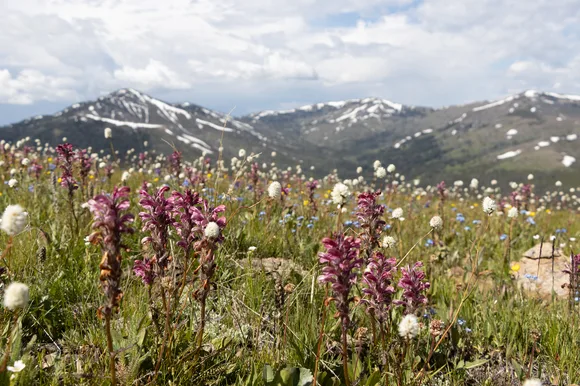
August means wildflowers in the high meadows and elk bugling in the northern ranges. It also means full campgrounds and parking lots that overflow by mid-morning at Grand Prismatic Spring and the Canyon Village overlooks. But the park's scale works in your favor. Hike past the first mile of any trail and you'll find space. Drive the northeast entrance road through Lamar Valley at dawn and you'll spot grizzlies digging for roots while tourists sleep in. The Grand Loop Road connects the marquee sites in a figure-eight that takes five hours to drive without stops, which means most visitors cluster near Old Faithful, Mammoth Hot Springs, and the canyon. Everything else is yours.
Grand Teton National Park
A tenth the size of Yellowstone / Jenny Lake fills by sunrise
Grand Teton is all verticality. The Teton Range rises 7,000 feet straight out of Jackson Hole with no foothills to soften the transition. Thirteen peaks top 12,000 feet, and you can see every one of them from the valley floor. The park condenses its drama into 485 square miles, which makes it easier to navigate but harder to escape the crowds. Jenny Lake, Cascade Canyon, and the Laurance Rockefeller Preserve pull most of the foot traffic, and parking lots fill before breakfast. You'll want a shuttle reservation for Jenny Lake or a willingness to arrive before 7 AM.
The Tetons don't build suspense; they hit you with the full alpine punch the moment you arrive.
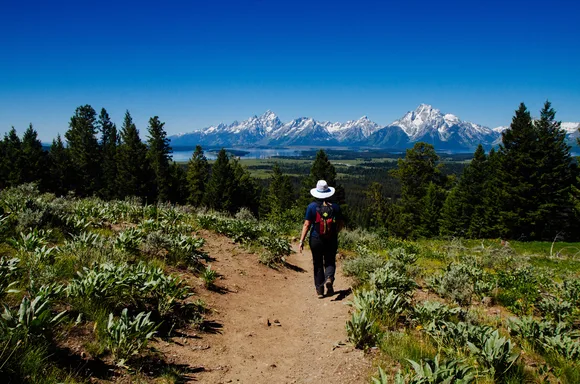
August brings wildflowers to Cascade Canyon and stable weather for summit attempts. If you're comfortable with exposure and scrambling, the trail to the Grand Teton summit via the Teton Crest is one of the great alpine routes in the Lower 48. If you're not, the String Lake Trail offers flat, family-friendly shoreline hiking with mountain reflections that photograph like postcards. The park's compactness means you can kayak Jackson Lake in the morning, hike Cascade Canyon after lunch, and still catch sunset at Schwabacher Landing without spending three hours in the car.
Getting There
Jackson Hole Airport sits inside Grand Teton's boundaries, 12 miles from Moose. Bozeman is 90 miles from Yellowstone's north entrance in Gardiner. If you're flying in, Grand Teton wins for convenience. If you're road-tripping, both parks connect via the John D. Rockefeller Jr. Memorial Parkway, and you can see both in a week without backtracking.
Hiking
Yellowstone has six times the trail miles and far more terrain variety. You can hike through lodgepole forests, across sagebrush flats, up volcanic peaks, and along rivers that carve through rhyolite. Grand Teton's trails climb. Almost every worthwhile hike in the park gains elevation, and most of them gain it fast. If you want alpine lakes, talus fields, and views that stretch into Idaho, the Tetons deliver. If you want hot springs, geysers, and backcountry that doesn't require crampons, Yellowstone is the call.
Crowds in August
Both parks are busy, but the density differs. Yellowstone spreads its visitors across five distinct regions, and you can find solitude in the Bechler region or along the Thorofare without much effort. Grand Teton funnels most of its traffic into a handful of trailheads. The park's beauty is concentrated, and so are the people. You'll feel the difference at Jenny Lake, where the shoreline trail can feel like a sidewalk in August.
The Verdict
Choose Yellowstone if you want variety, space, and the weirdness of geothermal features that rewrite your understanding of what a landscape can do. Choose Grand Teton if you want alpine grandeur without the driving, and if you're ready to start hiking the moment you arrive. Both parks reward early mornings and midweek visits. Both are worth more than a day trip.