10 Longest Trails in the National Parks
The ten longest trails in the national parks all happen to be at Crater Lake, from a half-mile stroll to a 33-mile sufferfest
You can hike the longest trail in the national park system and still have daylight to spare, or you can walk barely half a mile and claim you've conquered one of America's most iconic volcanic landmarks. Length matters less than what happens along the way, but when you're chasing distance as its own reward, these ten trails represent the outer edge of what you can cover on foot in a single park without crossing into overnight territory.
All ten of these routes happen to be at Crater Lake, which says something about the park's habit of turning a volcanic collapse into an excuse for serious mileage. The trails range from a leisurely stroll to a dawn-to-dusk endurance test, but each one offers a different angle on a lake so blue it looks Photoshopped.
Rim Trail (Full Loop), Crater Lake
A 33-mile circumnavigation of America's deepest lake / Dawn to well past dark
The Rim Trail is what happens when you decide the sampler platter isn't enough and order the entire menu. This full loop around Crater Lake tracks the caldera rim for 33 miles, climbing and descending through roughly 2,500 feet of cumulative elevation gain as it weaves between forest and open volcanic rock. Most visitors cherry-pick sections and call it a day, which is the sensible approach. Tackling the entire rim in one push is a sufferfest that requires starting before sunrise and finishing well after sunset, even in the height of summer.
You'll see every angle of the lake's impossible blue, every mood of light, and probably question your life choices somewhere around mile 23.
The trail itself is a mix of paved rim paths, dirt singletrack, and stretches where you're essentially bushwhacking along the crater edge. Water sources are scarce, shade is inconsistent, and the exposure to both sun and cliff edges demands respect. But if you're a completionist who needs to say you walked the whole thing, this is your Everest without the altitude sickness. Just know that most people who finish it don't talk about doing it again.
Crater Peak, Crater Lake
Six and a half miles to a volcanic summit / Grasslands and wildflowers
Crater Peak sneaks up on you. The first mile lulls you through quiet mixed-conifer forest, the kind of easy walking that makes you wonder what all the fuss is about. Then the trail opens into rolling grasslands and starts climbing in earnest, a steady push that reminds you that this is still a mountain, even if it's not the famous one. The elevation gain isn't brutal compared to alpine slogs elsewhere, but the exposed final stretch turns into a test of will when the sun is high.
From the summit, you get a perspective on Crater Lake that most visitors never see — a side angle that reveals the scale of the caldera and the surrounding volcanic landscape.
The payoff is solitude. While crowds bottleneck at the main rim viewpoints, you'll likely have Crater Peak to yourself, along with a 360-degree panorama that includes Mount Thielsen, Mount Scott, and the entire southern Oregon Cascade spine. Wildflowers peak in late June and early July, turning the meadows into a wildfire of lupine and paintbrush. Bring a wind layer for the summit, where the breeze can turn sharp even in August.
Boundary Springs, Crater Lake
Five miles to the birthplace of the Rogue River / Forest shade and meadows
This is one of those trails that rewards you with something genuinely rare: the actual birthplace of the Rogue River, bubbling up from the earth in a clearing you might walk right past if you weren't looking. The path winds through a mixed conifer forest that stays mercifully shaded for most of the route, with only modest elevation change that makes it feel more like a forest walk than a mountain hike. The tread is soft, carpeted with pine needles, and the air smells like a Christmas tree farm.
The springs themselves are less dramatic waterfall and more geological curiosity — water emerging from underground lava tubes to form the headwaters of a river that eventually carves its way to the Pacific.
Wildflowers peak in late July and early August, when the meadows near the springs turn into a riot of color. The trail sees a fraction of the traffic that clusters around the rim, which means you'll likely have the springs to yourself. It's the kind of hike that doesn't inspire Instagram posts but delivers something quieter and more satisfying: a sense of discovering something that feels untouched.
Stuart Falls Trail, Crater Lake
Three and a half miles through old-growth forest / Waterfall payoff
Stuart Falls Trail is one of Crater Lake's quieter escapes, a forested ramble that trades the rim's volcanic drama for old-growth shade and the sound of moving water. The path drops gradually through a thick corridor of mountain hemlock and Shasta red fir, with the kind of soft, needle-carpeted tread that feels like walking on memory foam. The elevation loss is gentle enough that you barely notice it on the way down, which means you're in for a moderate climb on the return.
The falls themselves are modest by Cascade standards, but they tumble through a moss-draped grotto that feels like stepping into a Pacific Northwest postcard.
The trail sees a fraction of the traffic that clusters around the main rim attractions, which makes it a solid choice for anyone who wants to escape the shoulder-to-shoulder viewpoints at Rim Village. The forest stays cool even on hot August afternoons, and the shade makes it a good option for midday hiking when the exposed rim trails are too punishing. Just remember that you're losing elevation the entire way in, which means earning it all back on the way out.
Cleetwood Cove Trail, Crater Lake
Two miles of switchbacks to lake level / The only legal water access
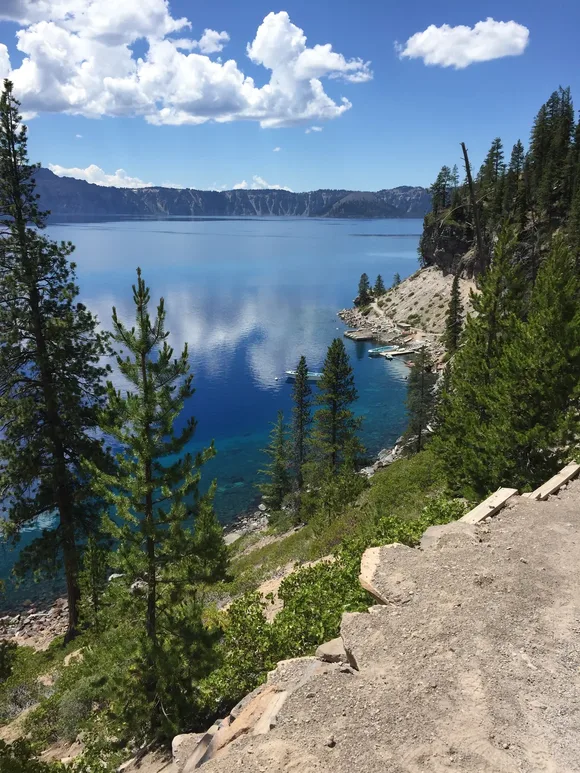
Don't let the short distance fool you. Cleetwood Cove is basically a staircase disguised as a trail. You'll drop roughly 700 feet in just over a mile, switchbacking down a steep, loose volcanic slope with increasingly jaw-dropping views of Crater Lake's impossible blue water. The trail is fully exposed, which means no shade and no mercy if you're hiking in the middle of the day. The descent is easy enough, but remember that every step down is a step you'll have to climb back up.
This is the only legal trail to the lake's edge, which makes it a bottleneck for boat tours, swimmers, and anyone who wants to say they touched the water.
The return climb is a lung-buster. You'll pass people sitting on rocks, red-faced and questioning their life choices, taking breaks every 50 feet. Start early if you can, before the sun turns the shadeless switchbacks into a convection oven. The reward at the bottom is access to water so clear you can see 30 feet down, and if you're brave enough to swim, it's cold enough to stop your heart.
Plaikni Falls, Crater Lake
Two miles of flat forest walking / Waterfall and wildflowers
Plaikni Falls is the kind of trail that makes you wonder why anyone bothers suffering on longer hikes. From the trailhead, you amble through dense old-growth forest of mountain hemlock and Shasta red fir, the canopy filtering light into soft green columns. The path is well-groomed and nearly flat, which makes it accessible for families and anyone who wants a nature walk without the punishment. The falls appear at the end of the trail, tumbling through a narrow gorge surrounded by wildflower meadows.
In mid-July, the meadows explode with lupine, paintbrush, and bistort, turning the falls into a backdrop for what might be the park's best wildflower display.
The trail is short enough to knock out in an hour, but most people linger at the falls, watching the water cascade down the volcanic rock while swallows dart through the mist. It's a peaceful spot that sees far fewer visitors than the main rim attractions, and the early morning light filtering through the forest makes it feel almost sacred. Come before 10 AM and you'll likely have the place to yourself.
Watchman Trail, Crater Lake
Less than two miles to a historic fire lookout / Sunset views over Wizard Island
The Watchman Trail packs a ridiculous reward into a short walk. From the trailhead on the west rim, you climb a gentle, well-maintained path through wildflower meadows and scattered mountain hemlock before the trail switchbacks up to the historic Watchman Lookout Station perched on the rim. The elevation gain is modest enough that families with young kids regularly make the climb, and the views start paying dividends almost immediately.
From the lookout, you get a postcard-perfect angle on Wizard Island and the full sweep of the lake, with light that turns golden in late afternoon.
This is one of the most popular short hikes in the park, which means you'll be sharing the trail with dozens of other visitors during peak season. But the crowds thin out in late afternoon, and if you time it for sunset, you'll get the best light of the day and a front-row seat to the lake's color deepening from cobalt to indigo. The lookout itself is staffed during fire season, and rangers are usually happy to talk about the history of the station and the geology of the caldera.
Discovery Point Trail, Crater Lake
Just over a mile along the rim / First recorded sighting of the lake
Starting from the west end of Rim Village, this out-and-back follows the crater rim through a mix of mountain hemlock forest and open volcanic rock. The trail rolls gently at first before hitting a modest climb, nothing brutal but enough to get your heart rate up on a warm afternoon. The path is well-maintained and paved for the first section, transitioning to dirt as you approach Discovery Point itself, the spot where prospector John Wesley Hillman became the first Euro-American to document the lake in 1853.
The viewpoint offers one of the classic angles on the lake, with Wizard Island in the foreground and the far rim stretching into the distance.
This is a solid choice for families and anyone who wants a taste of the rim experience without committing to a longer hike. The trail is short enough to knock out in an hour, but the views are expansive enough to feel like you've earned something. Come in late afternoon for the warmest light on the lake's famously saturated blue water, and you'll understand why early explorers thought they were seeing things.
The Pinnacles, Crater Lake
Less than a mile to volcanic spires / Geology lesson in miniature
This is barely a hike and entirely a spectacle. A flat, paved-quality path through dense forest delivers you to an overlook above Wheeler Creek Canyon, where dozens of volcanic spires rise from the gorge like a pipe organ carved by geology. These pinnacles formed when superheated gas and ash vented through layers of volcanic pumice, hardening the material around the vents into stone towers that now stand as tall as a 10-story building.
It's the kind of geological oddity that makes you stop and stare, trying to wrap your head around the forces that created something so alien.
The trail itself is negligible, but the payoff is worth the drive down the Pinnacles Road spur. Most visitors never make it this far from the rim, which means you'll likely have the overlook to yourself. Late afternoon light turns the spires into golden towers, and the forest around the canyon stays cool even on hot August days. It's a quick detour that delivers a completely different perspective on the volcanic forces that created Crater Lake.
Crater Lake Lodge Loop, Crater Lake
Half a mile of paved rim walking / Maximum payoff for minimum effort
This is the kind of walk you take when you want maximum payoff for minimum effort, and at Crater Lake, the payoff is staggering. The paved loop wraps behind the historic Crater Lake Lodge, delivering you to a rim-edge viewpoint where the deepest lake in America drops away beneath your feet in impossible shades of blue. The trail is fully accessible, which makes it a solid choice for anyone with mobility concerns or families with strollers.
You'll cover less than half a mile and see one of the most photographed views in the national park system.
The lodge itself is worth a look, a 1915 stone-and-timber structure that clings to the rim like it grew there. The loop is packed during midday, but if you time it for the golden hour before sunset, you'll get the best light on the lake and the lodge casting long shadows across the volcanic rock. It's the kind of walk that takes 20 minutes but delivers memories worth the entire drive to southern Oregon.